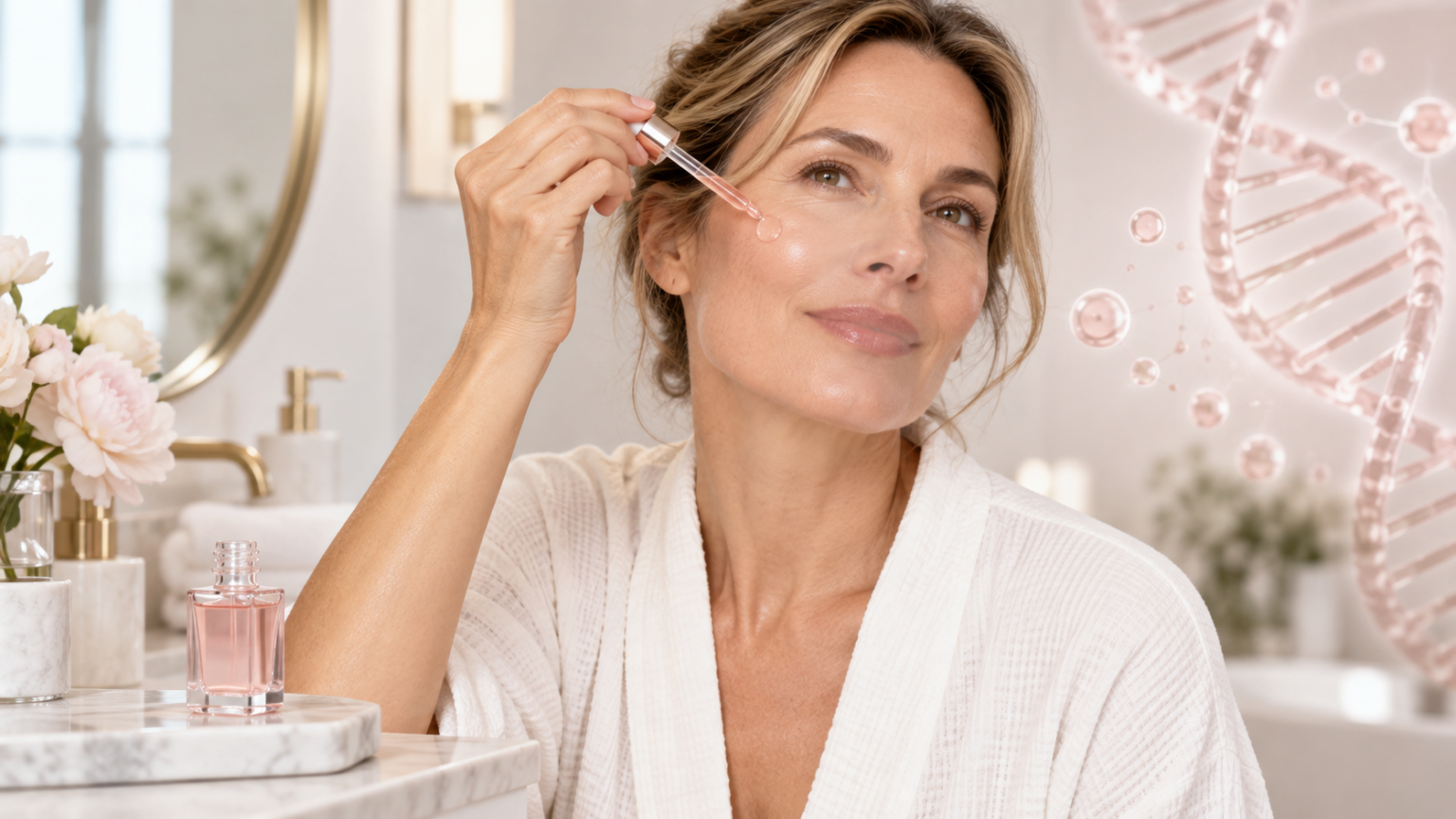
Dermatologist’s Quick Answer: PDRN has legitimate biological activity and has been studied in regenerative medicine, but the strongest evidence involves injected or medically delivered forms. For over-the-counter PDRN serums and masks, it is still unclear how much intact PDRN penetrates the skin or whether topical products can produce the dramatic anti-aging effects often promoted online.
What Is PDRN?
If you’ve spent any time looking at Korean skin care lately, you’ve probably seen four letters appearing everywhere:
PDRN.
PDRN stands for polydeoxyribonucleotide, a collection of small DNA fragments traditionally derived from salmon or trout.
That origin has helped give rise to one of skin care’s more attention-grabbing nicknames: “salmon sperm skin care.”
But the name is somewhat sensationalized and needs more explanation!
PDRN is not simply raw salmon sperm placed into a face cream. It refers to purified DNA fragments that have been studied for their potential effects on tissue repair, inflammation, wound healing, and cellular regeneration.
PDRN has a longer history in regenerative medicine than many people actually realize. But, the controversy is not whether PDRN has any biological activity.
The more important question is:
Can a PDRN serum applied to intact skin actually deliver enough of it where it needs to go to produce meaningful anti-aging results?
That’s where things become much less certain.
Why Is PDRN Suddenly Everywhere?
PDRN has become one of the biggest K-beauty trends of 2026.
It’s virtually everywhere, appearing in:
- Serums
- Sheet masks
- Eye patches
- Moisturizers
- Ampoules
- Injectable treatments
- Post-procedure products
Major beauty publications are uber excited about PDRN as one of the year’s ‘hot’ ingredients, and interest has increasingly shifted from the viral phrase “salmon sperm facial” toward searches for terms such as PDRN serum and PDRN skin care.
And that shift actually matters.
PDRN is moving away from being a novelty and becoming something that many of us are actually considering adding to our routines.
But popularity and scientific proof are not the same thing. Let’s dive in.
What Is PDRN Supposed to Do for the Skin?
PDRN products are commonly marketed for:
- Fine lines and wrinkles
- Improved elasticity
- Increased collagen production
- Skin repair
- Hydration
- Reduced inflammation
- Improved skin texture
- A brighter or…buzzy term incoming…“glass skin” appearance
See popular PDRN skin-care products.
There are biologically plausible reasons researchers are interested in PDRN.
It May Influence Tissue Repair
PDRN has been studied for its potential role in tissue regeneration and wound healing.
One proposed mechanism of how it works involves the activation of the adenosine A2A receptor, which may influence inflammation, blood vessel formation, and tissue repair.
That science is legitimate.
But there’s an important distinction that often disappears in social-media and influencer buzz:
Evidence that an injected ingredient can affect deeper skin tissue does not automatically prove that the same ingredient works when placed on top of the skin.
Does Topical PDRN Actually Penetrate the Skin?
This is probably the most important question in this whole PDRN conversation.
Your skin is designed to keep things out.
The outermost layer—the stratum corneum—is a highly effective barrier. Large molecules generally have difficulty penetrating your intact skin.
PDRN is made up of DNA fragments, which are much larger than many traditional skin-care ingredients.
That creates what we dermatologists like to call a ‘delivery problem.’
Many question whether standard topical PDRN molecules can penetrate deeply enough into the skin to reach the cells where many of the proposed regenerative effects would actually need to occur.
But hold on, this does not mean that every topical PDRN product is useless!
Formulation matters.
Companies might try to improve delivery through:
- Smaller DNA fragments
- Liposomes or other encapsulation systems
- Microneedle patches
- Post-procedure application
- Novel delivery vehicles
But the problem can be that consumers rarely receive enough information about molecular size, concentration, or delivery technology to know whether a particular serum meaningfully solves the penetration problem enough for them to achieve the results they’re looking for.
Why Do People Say Their PDRN Serum Makes Their Skin Look Amazing?
This is where things get interesting.
Someone can use a PDRN serum and genuinely notice that their skin looks better. That’s actually not hype.
But that doesn’t necessarily prove that PDRN itself is responsible.
Many PDRN products also contain familiar cosmetic ingredients such as:
- Hyaluronic acid
- Glycerin
- Niacinamide
- Peptides
- Ceramides
- Antioxidants
- Emollients
These ingredients can improve hydration and temporarily make your skin look smoother, plumper, and more luminous.
So when someone applies a PDRN serum and wakes up with “glass skin,” the improvement may be real—but we cannot necessarily attribute the entire effect to PDRN.
That distinction is frequently lost in all of those tantalizing before-and-after videos.
What About PDRN Injections?
Now, this is a different conversation.
Injected PDRN treatments bypass the outer skin barrier and place the material directly into tissue.
As a result, injectable treatments have a more plausible route to actually producing biological effects.
Clinical research on injectable polynucleotides and PDRN suggests potential improvements in skin texture, elasticity, dermal thickness, and wrinkle appearance. However, protocols and products can definitely vary, and more high-quality research is still needed.
It’s also important for U.S. consumers to understand that PDRN injectables are not FDA-approved for cosmetic use in the United States.
Now, that’s very different from saying they have no scientific basis.
It means that regulatory approval, standardized formulations, safety data, and clinical use differ from those of FDA-approved cosmetic injectables.
Is PDRN the Same as Exosomes?
No.
These two trends are often grouped together under the umbrella of “regenerative skin care,” but they are different.
PDRN
PDRN consists of purified DNA fragments.
Exosomes
Exosomes are tiny extracellular vesicles released by cells. They can carry proteins, lipids, and genetic material that influence communication between cells.
Both categories are marketed for skin rejuvenation, but both also face unanswered questions regarding sourcing, manufacturing, delivery, and the strength of evidence behind topical product claims.
If you see a product labeled “Exo-PDRN”, don’t assume that combining two trendy terms automatically creates stronger clinical evidence.
What About Plant-Based or Vegan PDRN?
This is one of the newer twists in the trend.
Because traditional PDRN is derived from fish DNA, some brands now market plant-derived or “vegan PDRN” alternatives.
You may see terms such as:
- Plant PDRN
- Vegan PDRN
- Phyto-PDRN
- Rice PDRN
- Ginseng PDRN
These ingredients may have interesting biological properties, but they aren’t necessarily chemically or clinically equivalent to traditional salmon-derived PDRN.
Some experts have even cautioned that plant-derived versions are arriving faster than supporting clinical evidence.
Whenever a familiar scientific term gets stretched across multiple unrelated ingredients, it becomes especially important to look beyond the marketing label.
Is PDRN Safe?
Topical PDRN products are generally marketed as cosmetics, and many people will probably tolerate them without difficulty.
However, “trendy” doesn’t mean universally safe.
Potential concerns include:
Irritation
The PDRN itself may not be the problem. Fragrance, preservatives, acids, botanical extracts, or other ingredients in the formulation may cause irritation.
Allergic Reactions
Anyone with fish allergies may understandably wonder about salmon-derived PDRN.
The degree of allergenic protein remaining after purification will depend on manufacturing, but consumers with significant fish allergy should discuss use with their doctor rather than assuming every product is safe.
Post-Procedure Use
I would recommend being particularly cautious about applying trendy cosmetic serums immediately after procedures such as:
- Microneedling
- Laser resurfacing
- Chemical peels
- Radiofrequency microneedling
Once the skin barrier has been intentionally disrupted, ingredients that normally remain on the surface may penetrate more deeply.
That changes the safety calculation considerably.
A product being sold as a cosmetic serum doesn’t necessarily mean it has been tested for introduction into freshly treated skin.
Is PDRN FDA Approved?
This question deserves careful wording.
PDRN may appear in cosmetic products sold in the United States, but that does not mean the FDA has reviewed or approved those products for treating wrinkles, regenerating skin, or altering tissue structure.
Cosmetics generally do not undergo FDA premarket approval in the same way prescription drugs do.
Likewise, injectable PDRN products are not currently FDA-approved for cosmetic injection in the United States.
Should You Buy a PDRN Serum?
If you enjoy trying new skin-care products and the formula contains ingredients that otherwise make sense for your skin, a PDRN serum is not automatically unreasonable.
But I’d be sure to approach the situation with realistic expectations.
I wouldn’t pay a large amount of money just because a product contains PDRN.
Instead, look at the entire ingredient list.
A good formula should still provide things your skin can clearly benefit from, such as:
- Humectants for hydration
- Barrier-supporting ingredients
- Antioxidants
- Proven anti-aging ingredients
- A formulation appropriate for your skin type
If the PDRN turns out to provide additional benefit, great.
But your entire routine shouldn’t depend on an ingredient whose topical efficacy is still being worked out.
What Has Better Evidence for Skin Aging?
If your main concern is fine lines, wrinkles, texture, or discoloration, several approaches have much stronger evidence.
Sunscreen
Daily broad-spectrum sunscreen remains one of the most important ways to prevent premature skin aging.
Retinoids
Prescription tretinoin and over-the-counter retinoids have decades of evidence supporting their benefits for photoaging, fine lines, and skin texture. Popular over-the-counter options include products from brands such as CeraVe, and RoC
Moisturizers
A well-formulated moisturizer can improve hydration and make fine lines appear less prominent.
Vitamin C
Certain properly formulated vitamin C products may help protect against oxidative stress and support an anti-aging routine.
In-Office Treatments
Depending on your goals, a dermatologist may discuss options such as:
- Botulinum toxin
- Chemical peels
- Microneedling
- Laser resurfacing
- Radiofrequency treatments
- Dermal fillers
None of these is appropriate for everyone, but their roles are far better established than the claims surrounding many viral regenerative serums.
My Dermatologist’s Verdict on PDRN
PDRN is one of those trends where the answer is neither:
“This is nonsense.”
nor:
“Everyone needs this immediately.”
The biology behind PDRN is interesting.
There is credible research supporting regenerative effects under certain conditions, particularly when PDRN is delivered in ways that bypass the skin barrier.
But the leap from that science to:
“This $40 serum will regenerate my skin because it contains salmon DNA”
is much larger than social media might have you believe!
For topical PDRN, the most important unanswered questions are still:
- How much actually penetrates intact skin?
- What concentration is present?
- What size are the DNA fragments?
- How is it delivered?
- Which benefits come from PDRN versus the other ingredients in the formula?
- Do improvements persist with continued use?
My advice is to stay curious—but keep healthy skepticism.
Skin-care trends sometimes become tomorrow’s evidence-based treatments.
Others simply become tomorrow’s forgotten products.
So, PDRN is interesting enough to watch, but the science has not yet caught up with all of the marketing.
Frequently Asked Questions About PDRN Skin Care
What does PDRN stand for?
PDRN stands for polydeoxyribonucleotide, which refers to purified DNA fragments commonly derived from salmon or trout.
Is PDRN really made from salmon sperm?
Traditional PDRN is generally derived from salmonid reproductive cells, which is why the phrase “salmon sperm facial” became popular online. The material used in medical and cosmetic formulations is purified DNA-derived material rather than raw reproductive tissue.
Does PDRN serum really work?
Topical PDRN may be beneficial, but evidence is still limited. The biggest unanswered question is whether enough PDRN penetrates intact skin to reproduce the regenerative effects demonstrated with other delivery methods.
Does PDRN increase collagen?
Laboratory and medical research suggests PDRN might influence the pathways involved in tissue repair and collagen activity. However, it hasn’t been clearly established that an over-the-counter PDRN serum reliably increases collagen in human facial skin.
Can PDRN reduce wrinkles?
Some PDRN products may improve hydration and skin appearance, and injectable treatments have shown promising results. But, there isn’t yet strong evidence that ordinary topical PDRN serums can substantially reduce established wrinkles.
Is PDRN better than retinol?
At this point, retinoids have considerably more clinical evidence for treating photoaging and fine lines. I wouldn’t replace a well-tolerated retinoid with PDRN just because PDRN is trending with all the influencers.
Can you use PDRN with retinol?
Potentially, yes. Whether the combination is appropriate depends on the complete formulations and how sensitive your skin is. Introduce new products gradually if you’re prone to irritation.
Is PDRN safe for sensitive skin?
That depends on the entire formulation. PDRN itself might be well tolerated, but fragrance, preservatives, acids, or botanical ingredients in some serums might still irritate sensitive skin.
Is PDRN FDA approved?
PDRN-containing cosmetics can be sold in the United States, but that doesn’t mean they are FDA-approved to treat wrinkles or regenerate skin. Injectable PDRN products are also not currently FDA-approved for cosmetic use in the United States.
Is PDRN worth the money?
It depends on the product and your pocket book perspective. That being said, I would judge a PDRN serum by its complete formulation rather than paying a large premium simply because “PDRN” appears on the label.